
What Is an ERP System? Meaning, Modern Architecture & Enterprise Guide
What is an ERP system? Explore ERP meaning, core operational modules, 4-tier cloud architecture, event-driven integration fabrics, and modernization strategies.
HyperCode
Technology Consulting

Modern organizations generate critical operational data every time they fulfill an order, pay a vendor, schedule staff, or manage inventory. Learn how modern ERP software development services connect fragmented workflows, integrate core business systems, improve operational visibility, and support scalable growth.
Strategic Foundations
Modern organizations generate vital business information every time they sell a product, pay a supplier, schedule an employee, purchase inventory, or resolve a customer support inquiry. Yet when this information is scattered across isolated spreadsheets, departmental databases, and disconnected software tools, teams inevitably suffer from inconsistent records, delayed managerial approvals, and blind spots that hinder executive decision-making. An enterprise resource planning (ERP) platform coordinates these disparate activities through standardized business logic, automated cross-functional workflows, and shared operational data.
ERP software development services help forward-thinking organizations plan, design, build, integrate, extend, and maintain the enterprise technology that powers these mission-critical processes. However, a successful ERP modernization initiative is not always defined by building a completely custom ERP from the ground up: for many organizations, configuring an established commercial platform and engineering targeted custom extensions provides a far more pragmatic balance of speed, capital investment, and operational flexibility. The ultimate objective is to deploy a solution that mirrors actual operations and yields measurable process improvements rather than simply replacing legacy tools with newer ones.
An ERP system should adapt to how your business creates competitive advantage—not force your teams to contort high-value processes into rigid software constraints.
Ecosystem Model
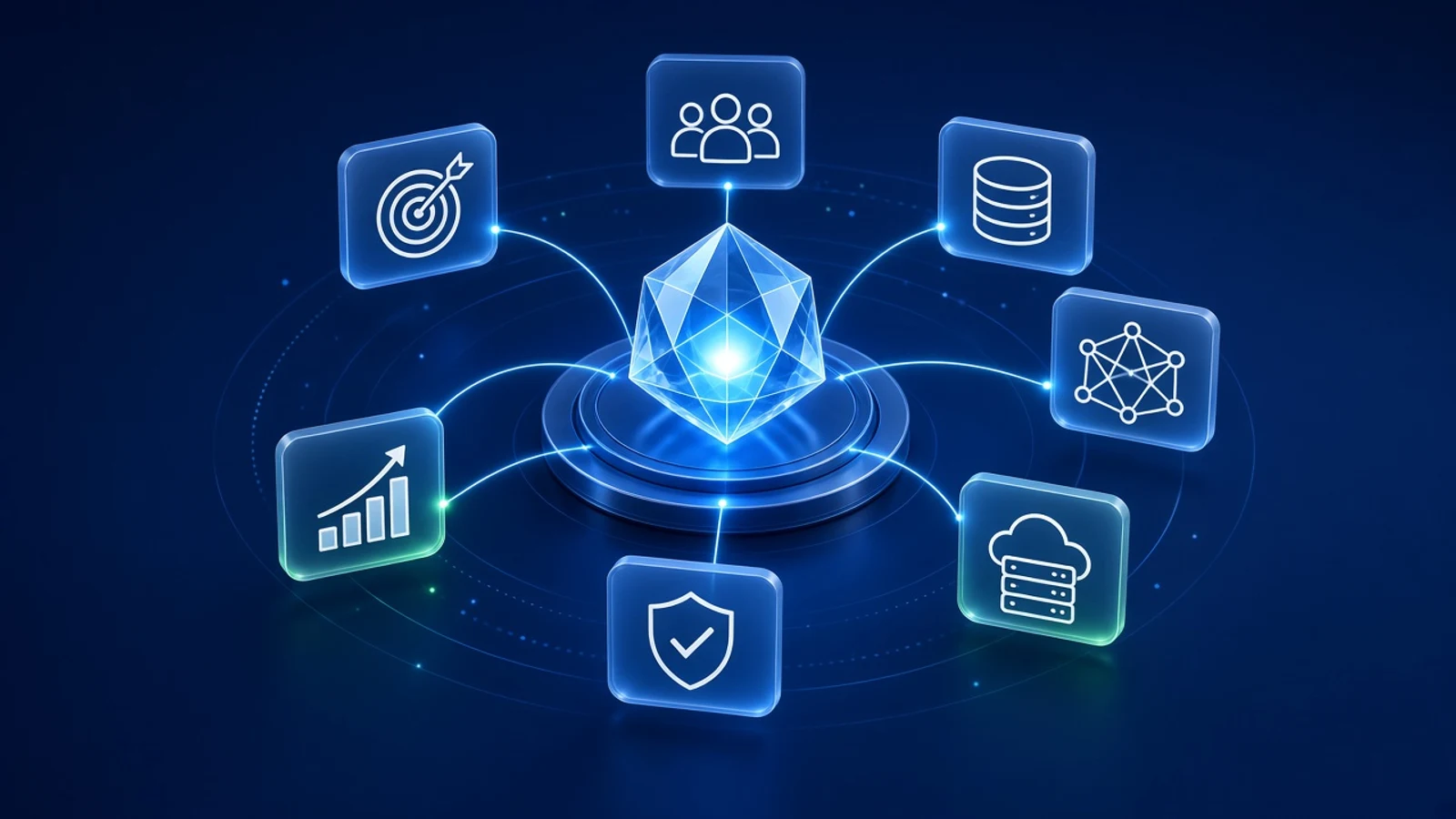
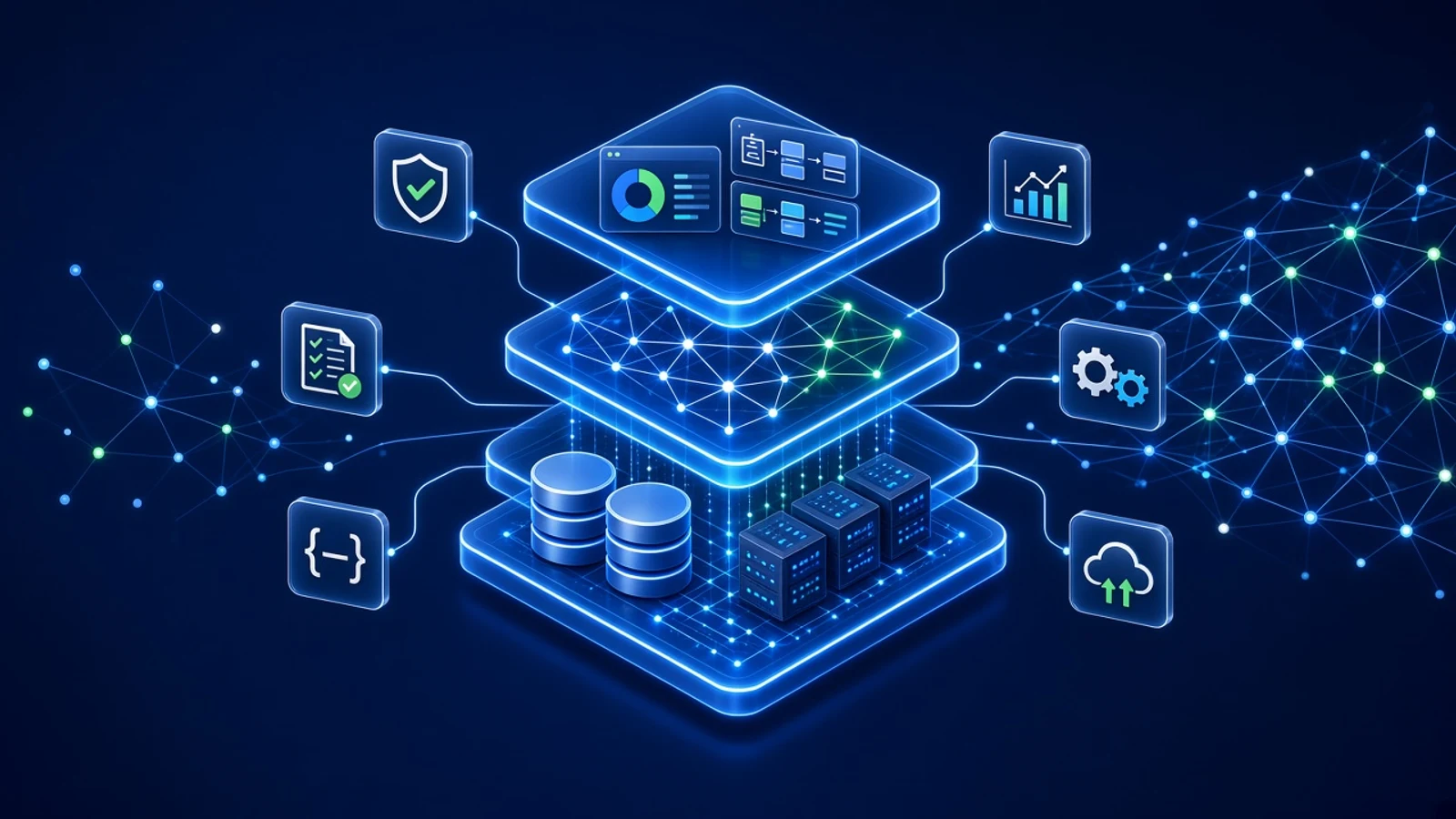
At its architectural heart, a modern enterprise ERP functions as the central nervous system of an enterprise. Rather than existing as a standalone accounting database, it connects operational teams, transactional data streams, and external digital partners into a synchronized operational ecosystem:
Architectural Model
General ledger, accounts payable, receivables, cash flow forecasting, and automated multi-entity consolidation.
Omnichannel order capture, custom pricing matrices, tiered discount approvals, and contract fulfillment.
Unified customer accounts, purchase histories, credit limits, ticket resolution, and field support coordination.
Multi-location stock tracking, automated reorder thresholds, lot/serial tracking, and barcode scanning.
Vendor procurement pipelines, purchase orders, carrier shipping integrations, and freight tracking.
Employee scheduling, time tracking, commission calculations, benefits administration, and compliance records.
Work-order scheduling, bill of materials (BOM), assembly routing, quality control, and machine telemetry.
Real-time executive dashboards, operational KPI tracking, gross margin reporting, and predictive forecasts.
Figure 1: The modern ERP connects cross-functional business capabilities through unified data contracts, APIs, and standardized business rules.
Evaluation Framework
When evaluating an ERP modernization, technology leaders must determine whether to procure a commercial off-the-shelf platform, build a purpose-built custom solution, or pursue a pragmatic hybrid approach. Each path entails distinct architectural, operational, and financial trade-offs:
Strategic Comparison
Key Advantages: Mature accounting functionality, established vendor support, pre-built regulatory reports, and a rapid initial baseline.
Trade-offs: High recurring per-user license fees, rigid workflows, difficult customization, and vendor release roadmap dependency.
Best For: Companies with standard accounting operations who can readily adapt their processes to match industry-standard software conventions.
Key Advantages: Exact alignment with proprietary business logic, zero recurring seat license overhead, complete codebase ownership, and tailored user UX.
Trade-offs: Direct internal responsibility for security audits, developer documentation, long-term maintenance, and infrastructure updates.
Best For: Enterprises with unique manufacturing, logistics, or delivery models where off-the-shelf limitations restrict operational agility.
Key Advantages: Combines proven commercial accounting and payroll backends with custom-engineered extensions, customer portals, and integration middleware.
Trade-offs: Requires robust API governance and data synchronization monitoring between third-party systems and custom services.
Best For: Growing mid-market and enterprise businesses seeking rapid time-to-value while retaining complete control over proprietary differentiation.
Figure 2: Comparing foundational ERP delivery models to align technical architecture with business strategy and total cost of ownership.
A hybrid ERP approach—retaining established systems for commodity accounting while developing custom services for competitive differentiation—is often the most cost-effective and agile strategy. For organizations evaluating these pathways, our specialized ERP development services provide the architectural discovery and engineering execution needed to assess, design, and deploy the right balance.
Value Drivers
Whether modernizing an existing legacy platform or engineering custom capabilities, engaging specialized ERP software development services delivers five transformative operational advantages:
An ERP platform succeeds when employees can execute daily operational tasks with fewer unnecessary steps, lower cognitive burden, and minimal manual data entry. Experienced engineering teams begin by interviewing frontline stakeholders, mapping multi-tiered approval paths, and pinpointing exact friction points where workflows currently bounce between email threads, paper forms, and static spreadsheets.
Consider a wholesale distributor managing complex account relationships: standard retail software cannot accommodate tiered volume pricing negotiated per contract, automated credit-limit validations linked to payment history, or fulfillment rules that route orders dynamically across multiple regional warehouses. Tailored ERP engineering codifies these specific business rules into software, automating compliance checks while empowering authorized personnel to review exceptions smoothly.
Operational Workflow
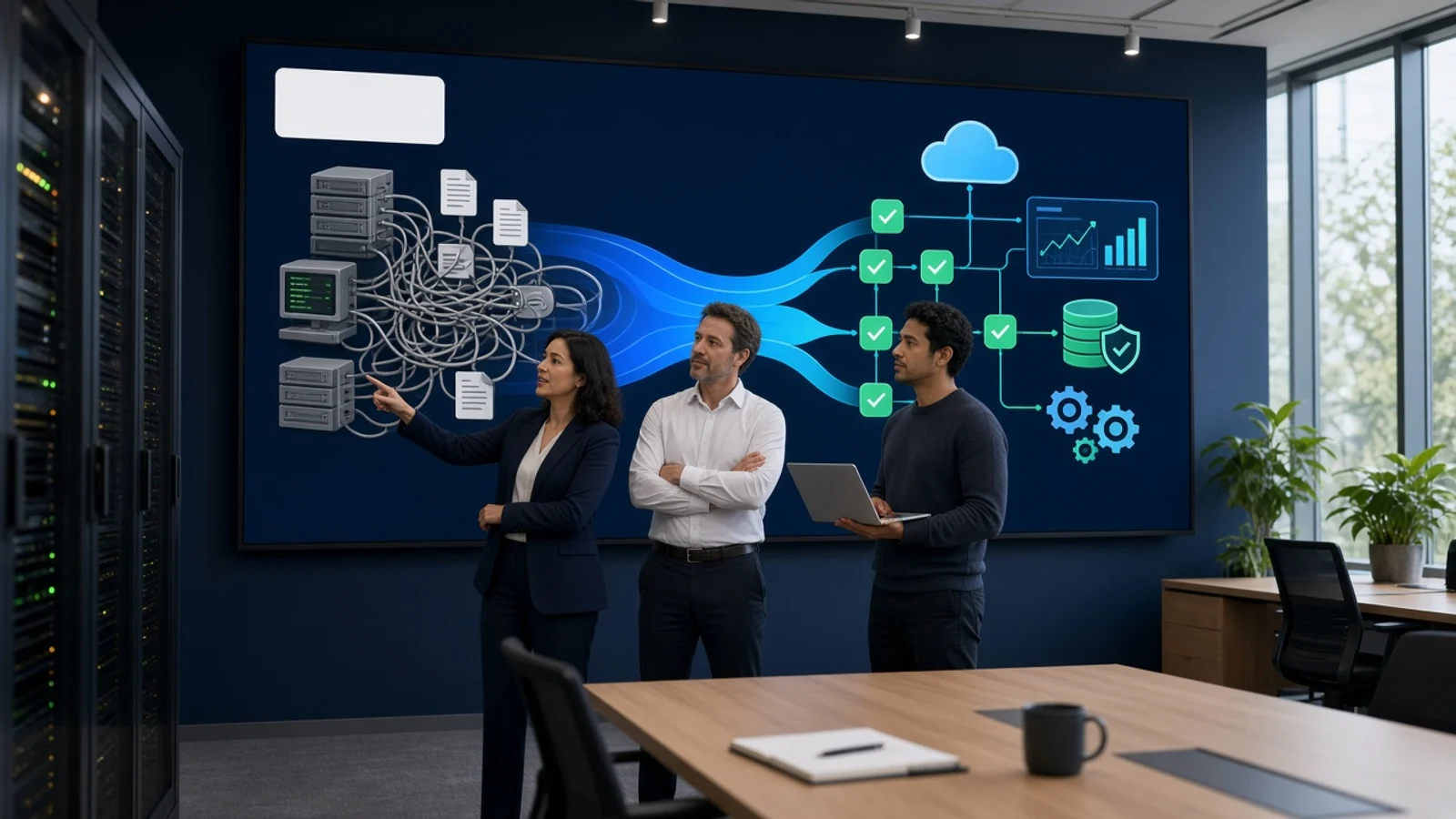
Orders received via email; manually rekeyed into accounting; stock verified by phone; fulfillment tracked in spreadsheets; inconsistent records and delayed customer answers.
Orders captured via API; instant inventory reservation; automated credit checks; digital picking slips routed to warehouse handhelds; tracking auto-synced.
Order-to-fulfillment cycle times plummet; error rates drop; administrative overhead decreases; and new team members onboard in days instead of months.
Figure 3: Transforming fragmented manual handoffs into an automated, auditable, and accelerated ERP execution pipeline.
Standardize and streamline inefficient workflows before codifying them into code. Custom software development should protect and scale your true competitive advantage—not institutionalize avoidable procedural complexity.
As an enterprise expands, its operational demands multiply exponentially. A growing business may acquire a regional competitor, open secondary distribution centers, launch direct-to-consumer digital subscriptions, or expand into cross-border tax jurisdictions. Rigid legacy software often crumbles under this complexity, requiring expensive workarounds or complete platform replacements.
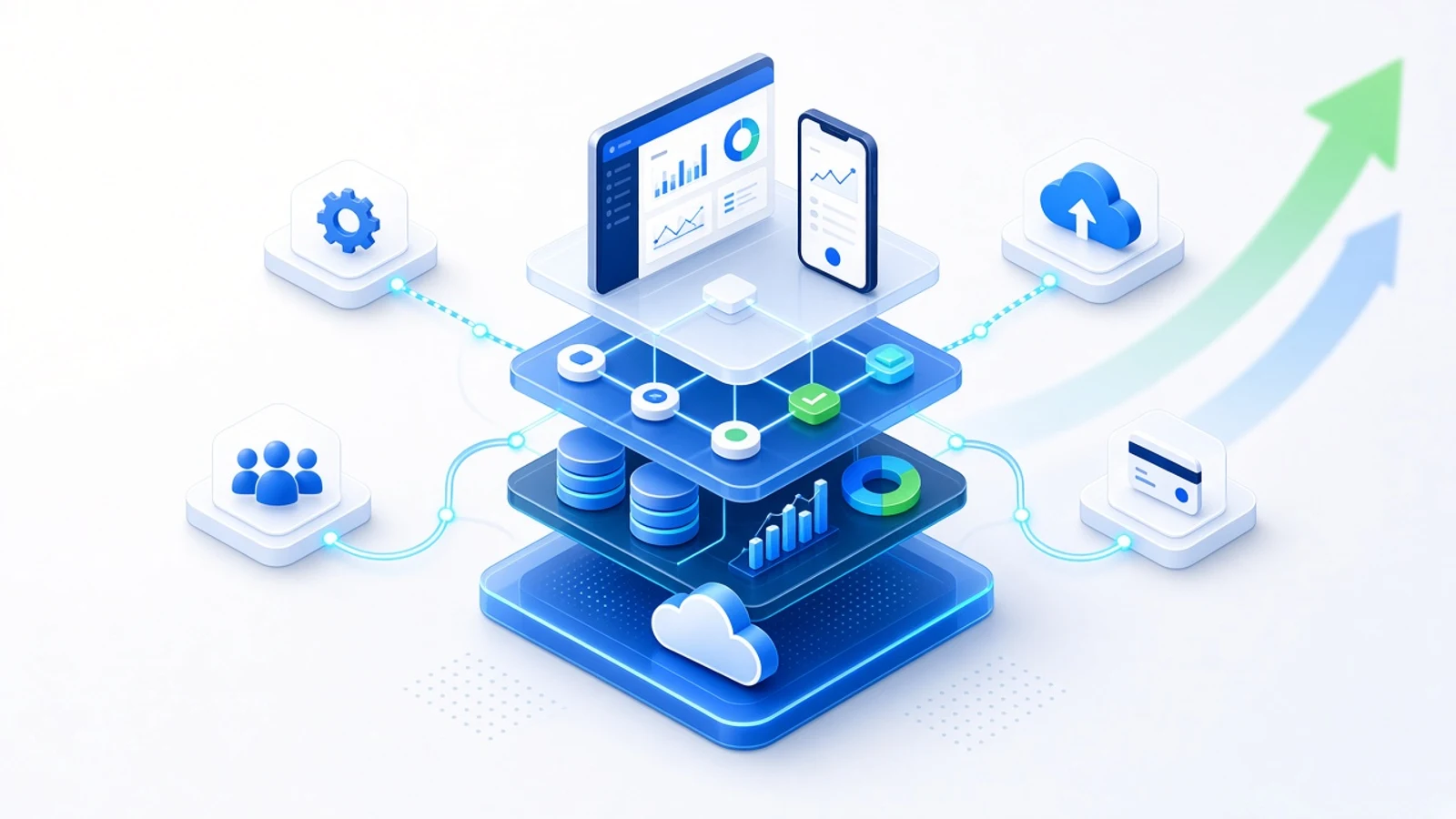
Modern ERP architecture embraces modularity and domain-driven design, decoupling business capabilities into independent modules with robust data contracts. This allows engineering teams to introduce new sales channels, onboard thousands of concurrent users, or deploy specialized reporting capabilities without destabilizing core financial ledgers. Scalability also encompasses proactive database indexing, caching strategies, high-concurrency traffic handling, and cloud cost governance.
System Architecture
Scales smoothly from dozens of internal operators to thousands of concurrent warehouse, mobile, and field users.
Multi-facility inventory routing, localized currencies, international tax tables, and omnichannel storefronts.
Independent modules for order management, manufacturing, procurement, and billing connected via clean APIs.
Containerized microservices, read-replica databases, automated load balancing, and multi-region failover.
Figure 4: A modular, elastic ERP architecture designed to support multi-facility expansion and high transaction volumes without performance degradation.
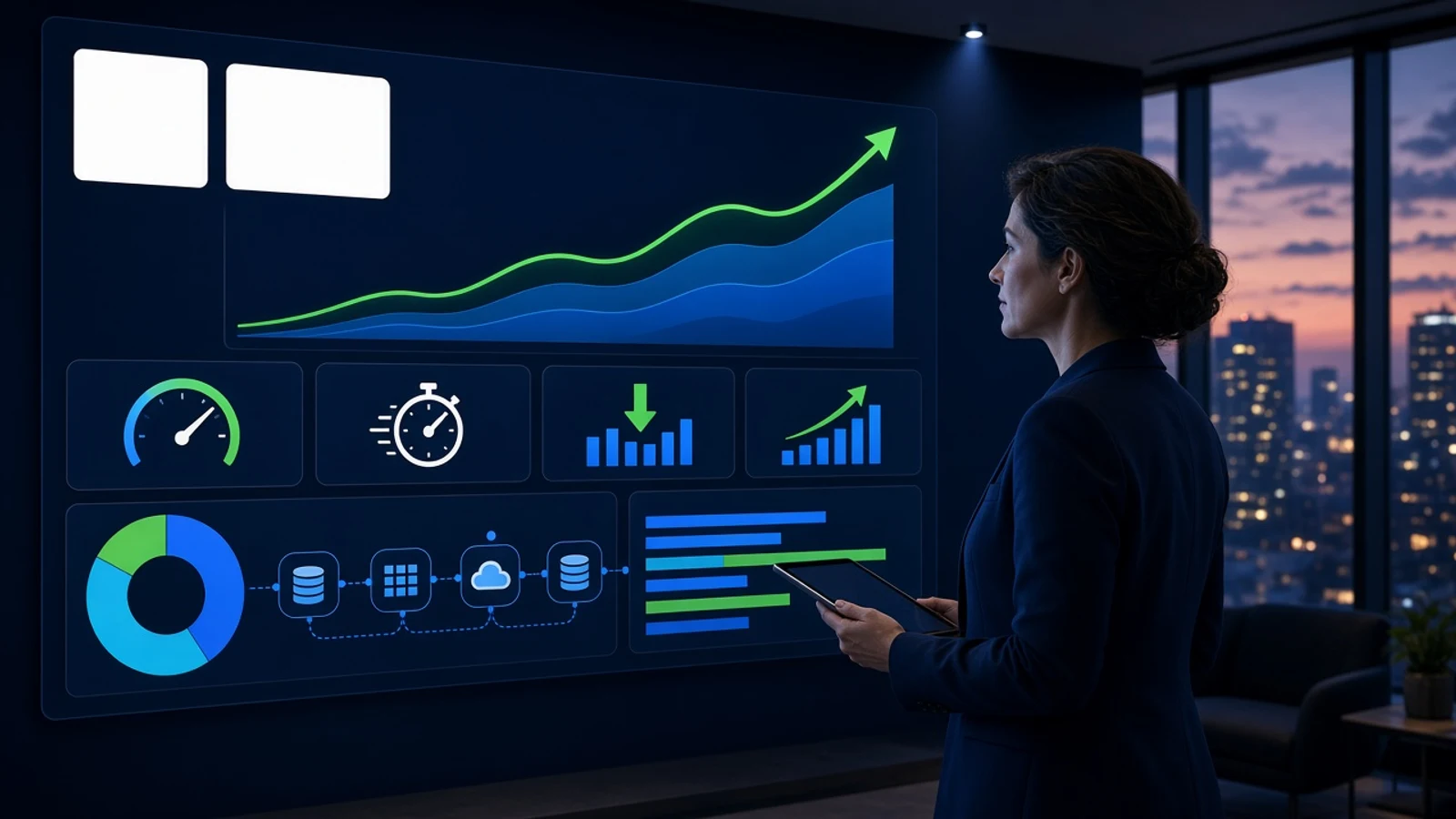
Executive leadership requires an unfiltered, continuous view into business operations—from outstanding purchase orders and stock availability to aging receivables and fulfillment bottlenecks. When disparate systems feed verified updates into a centralized ERP, business intelligence dashboards replace delayed, error-prone spreadsheets, surfacing actionable operational insights immediately.
However, architectural nuance is critical: true real-time visibility is not magic. In an enterprise system, an incoming sales order may reserve inventory instantly, but the corresponding general ledger entries follow strict revenue recognition and managerial approval cadences. True business intelligence depends on data governance, precise timestamps, single-source-of-truth ownership, and automated reconciliation pipelines.
Data Pipeline
Orders, picking updates, vendor receipts, and bank transactions trigger real-time system events.
Automated hygiene checks verify data integrity, timestamps, currency conversions, and entity mappings.
High-speed data lakes and analytical models aggregate metrics without taxing transactional operational databases.
Dashboards alert leadership to delayed shipments, low margin trends, and emerging supply chain risks in real time.
Figure 5: Structured data pipelines turn continuous transactional operational events into verified, executive-level business intelligence.
No enterprise operates in a vacuum. Sales teams depend on CRM platforms like Salesforce or HubSpot, consumers purchase through Shopify or custom web portals, transactions settle via Stripe, and regional carriers coordinate fulfillment. ERP development services engineer reliable integration bridges using REST/GraphQL APIs, asynchronous event brokers, webhooks, and middleware to orchestrate bi-directional data flow.
In an integrated e-commerce and ERP environment, an online checkout instantaneously triggers inventory decrementing, generates a picking ticket in the warehouse management system, posts preliminary accounting records, and dispatches tracking credentials back to the customer's portal—completely eliminating duplicate data entry, human transcription errors, and fulfillment delays.
Integration Ecosystem
Bi-directional synchronization of customer profiles, payment terms, custom quote approvals, and lifetime order histories.
Real-time product catalog updates, pricing synchronization, order intake, and unified return/exchange processing.
Automated payment capture, fraud scoring, recurring subscription billing, and automated bank reconciliation.
Automated shipping label generation, rate shopping, freight documentation, and tracking milestone telemetry.
Live foreign exchange rates, automated address verification, tax calculation services (e.g., Avalara), and supplier EDI.
Secure rate limiting, mutual TLS authentication, retry queues with exponential backoff, and dead-letter queue monitoring.
Figure 6: A resilient integration ecosystem connecting specialized enterprise platforms through secure, decoupled API gateways and event queues.
Because an ERP houses an organization's most sensitive financial ledgers, customer credentials, vendor banking details, and payroll data, cybersecurity cannot be treated as a post-development checklist item. Modern ERP engineering embeds security natively into the solution architecture using defense-in-depth methodologies.
Core controls include multi-factor authentication (MFA), strict role-based access control (RBAC), end-to-end encryption for data in transit and at rest, immutable audit logging, and automated backup schedules. While deploying an ERP does not automatically bestow regulatory compliance, a well-architected platform provides the technical controls necessary to satisfy stringent industry frameworks—such as HIPAA for healthcare patient accounting, GDPR for consumer data privacy, or SOC 2 for operational integrity.
Security Architecture
SSO integration, strict least-privilege role assignment, multi-factor authentication, and automated session revocation.
Industry-standard AES-256 encryption at rest, TLS 1.3 in transit, automated key rotation, and database column hashing.
Immutable append-only audit logging, continuous vulnerability scanning, intrusion detection, and verified disaster recovery.
Figure 7: Multi-layered security architecture protecting financial records, intellectual property, and customer identities.
Innovation Horizon
Modern ERP platforms are evolving beyond static database systems. Three technological shifts are transforming how enterprises deploy, interact with, and extract value from their operational software:
Execution Methodology
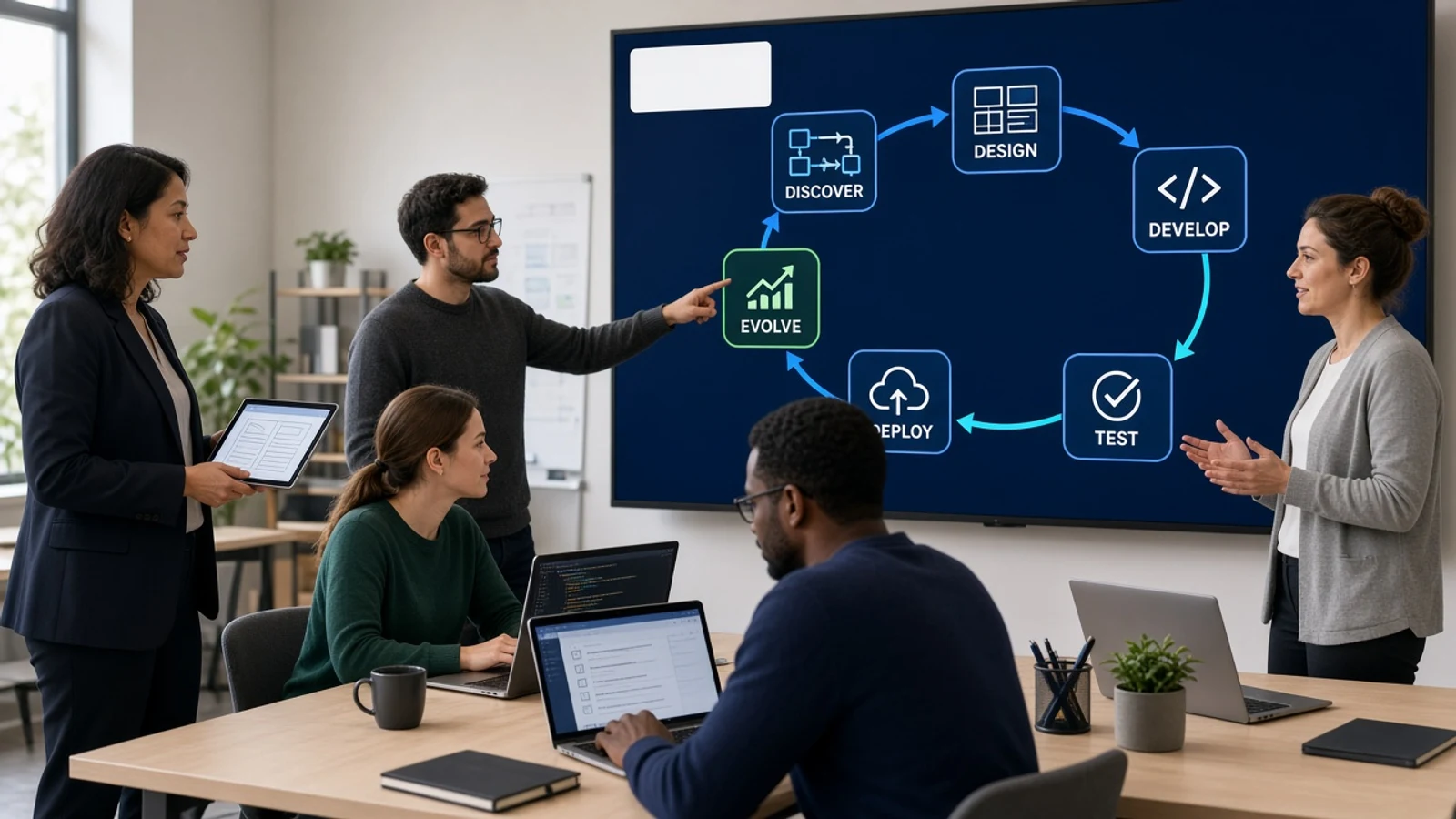
An ERP initiative is one of the most transformative investments an enterprise can make, but without disciplined planning, projects can suffer from scope creep and organizational fatigue. High-performing engineering teams execute through an outcome-focused, phased roadmap:
Implementation Methodology
Define clear business outcomes (e.g., faster financial close, reduced manual touches). Map existing workflows, dependencies, and data schemas.
Build a clickable working prototype of one end-to-end critical process (e.g., order to invoice). Test usability directly with frontline staff.
Engineer resilient API pipelines connecting CRM, eCommerce, and banking. Cleanse legacy data and execute initial migration dry runs.
Conduct rigorous end-to-end integration testing and user acceptance testing (UAT). Provide tailored, role-based training to all operational departments.
Execute a staged cutover (by department or business unit) with dedicated hypercare support and continuous operational monitoring.
Evaluate performance against baseline KPIs, optimize database queries, collect employee feedback, and roll out secondary modular features.
Figure 8: A proven, de-risked six-stage implementation methodology ensuring high adoption and measurable business returns.
Interactive Process Flow
Observe how a single transactional event—such as a customer placing an enterprise order—propagates across integrated functional domains in a modern, automated ERP architecture:
Interactive System Simulation
Order captured via portal or API.
Account terms & credit validated.
Rules & workflows orchestrated.
Stock reserved across warehouses.
Invoices posted & ledger updated.
Labels generated & carrier dispatched.
Operational telemetry logged.
Dashboards updated in real time.
Figure 9: The synchronized, multi-stage information lifecycle orchestrated by modern enterprise ERP systems.
Vertical Realities
While the underlying architectural discipline remains universal, modern ERP development addresses specific operational complexities across different industry sectors:
Dynamic tiered pricing matrices, multi-warehouse routing rules, container consignment tracking, and automated vendor rebating. Enables distributors to protect gross margins while accelerating shipping velocity.
Multi-level Bill of Materials (BOM), shop-floor IoT machine integration, work-in-progress (WIP) tracking, and predictive scrap reduction. Synchronizes production scheduling with real-time component availability.
Unified inventory visibility connecting physical retail POS terminals, digital storefronts, and third-party marketplaces. Eliminates stockouts and supports Buy-Online-Pick-Up-In-Store (BOPIS) fulfillment.
Mobile dispatching, job costing, subcontractor compliance tracking, equipment maintenance schedules, and time-and-materials billing. Empowers remote crews with offline-capable mobile workflows.
Strategic Conclusion
Modern ERP software development services possess the unique capability to transform disconnected, manual processes into synchronized, measurable workflows. The most enduring enterprise initiatives balance software flexibility with disciplined architecture, robust cybersecurity, resilient systems integration, and human-centered user adoption. Rather than pursuing customization for its own sake, organizations succeed by investing deliberately where tailored capabilities create sustainable competitive advantage.
Whether your business requires configuring an established commercial platform, engineering targeted custom modules, or developing a proprietary enterprise application, the ultimate objective remains constant: delivering an intuitive, scalable system that empowers your team to make better decisions and supports growth without adding operational friction.
BUILD AN ERP SYSTEM AROUND THE WAY YOUR BUSINESS WORKS.
HyperCode partners with business and technology leaders to assess operational workflows, design integrated architectures, engineer custom ERP extensions, connect legacy tools, and execute de-risked implementation roadmaps.
Enterprise FAQs
Explore practical answers to the most common architectural, operational, and strategic questions surrounding modern ERP software development services:
HyperCode
Technology Consulting
HyperCode is a Schaumburg, Illinois-based technology consulting and engineering company founded in 2014.
HyperCode helps organizations assess business processes, design integrated ERP solutions, build targeted extensions, connect existing systems, and plan scalable implementation.

What is an ERP system? Explore ERP meaning, core operational modules, 4-tier cloud architecture, event-driven integration fabrics, and modernization strategies.

Learn how IT staff augmentation helps organizations add specialized technology talent, scale engineering teams, close skill gaps, and support critical delivery initiatives.

A practical enterprise digital transformation strategy covering cloud modernization, data, automation, security, customer experience, governance, implementation, and measurable business impact.

Learn how IT staff augmentation firms help businesses close technology skill gaps, maintain delivery momentum, integrate specialized engineers, and strengthen long-term engineering capability.

Learn how IT staff augmentation agencies help engineering leaders add specialized capability, scale delivery, retain code ownership, integrate talent, and protect security and architectural control.

A practical guide to choosing the right technology talent partner for speed, capability and long-term business value.

Learn how strategic IT staff augmentation helps engineering teams add specialized capability, accelerate delivery, integrate expertise, and strengthen long-term technical capacity.

Learn how to evaluate a custom software development firm based on business fit, architecture, engineering depth, delivery discipline, security, integration, and long-term partnership.

Learn how custom business software development helps organizations improve efficiency, integrate systems, automate workflows, and generate long-term ROI through scalable digital solutions.

Learn why custom software development solutions help enterprises align technology with unique workflows, integrations, data, customer experiences, and long-term business growth.

Learn how organizations can modernize core enterprise systems while preserving valuable business logic, data, integrations, and operational knowledge.

Learn how custom software moves from business idea to dependable digital product through planning, design, engineering, testing, deployment, and continuous improvement.

A practical guide to how enterprise AI companies design intelligent systems through strategy, data, architecture, automation, and scalable implementation.

A practical framework for turning automation investment into measurable business value.

A practical guide to where enterprise AI software creates measurable business value.

A business-led guide to moving from AI opportunity to practical, secure and scalable enterprise execution.

A practical guide to choosing an enterprise AI platform that can scale with your business across data, security, integration, governance, flexibility, performance, and cost.

How purpose-built enterprise software helps organizations connect systems, automate workflows, modernize operations and create a scalable foundation for growth.

How organizations can use generative AI to improve operations, strengthen decision-making, accelerate innovation, and build secure, scalable AI capabilities.

A practical enterprise guide to healthcare AI automation, secure architecture, governance, clinical support, predictive analytics, and responsible implementation.